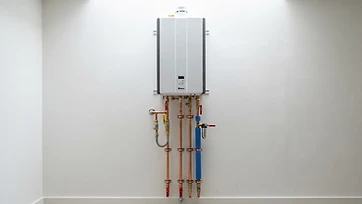
Backflow prevention keeps contaminated water from flowing backward into your clean supply. Here's what homeowners and business owners need to know about testing, devices, and the law.
A backflow preventer is the unsung valve that keeps the water in your pipes flowing one direction — clean supply in, waste out. When it works, you never think about it. When it fails, contaminated water can siphon back into the clean supply, and that's a serious health and code problem. Here's what homeowners and business owners need to know.
What backflow is
Backflow happens when water flows backward through the plumbing system — from where it's supposed to drain, back into the drinking water supply. It's caused by two things: back-pressure (when pressure downstream exceeds the supply pressure, like from a boiler or a pump) and back-siphonage (when a drop in supply pressure, like a water-main break, creates a vacuum that pulls water backward).
Without a working preventer, that reverse flow can carry chemicals, bacteria, fertilizers, or waste water straight into the clean supply that serves your home and your neighbours'.
Where backflow is a real risk
Some properties are higher risk than others. The classic examples:
- Irrigation systems. A lawn sprinkler submerged in a puddle is a direct path for fertilizer, pesticides, and soil bacteria back into the house supply the moment pressure drops.
- Boilers and hydronic heating. A boiler loop treated with glycol or corrosion inhibitor is a back-pressure hazard if it's not isolated.
- Hose connections. A garden hose left in a bucket of soapy water, a pool, or a pesticide sprayer is the most common residential backflow path there is.
- Commercial properties. Restaurants, car washes, dental offices, manufacturers, and anything with a chemical or process connection to the water supply are all backflow risks by definition.
The devices
There are a few types, sized to the hazard:
Hose-bib vacuum breakers screw onto a garden tap and are the simplest residential protection — cheap and effective for the hose problem. Dual-check valves protect single-family homes where the only hazard is a minor one. Reduced-pressure principle (RP) assemblies are the commercial-grade device — they have two check valves and a relief valve that dumps water the instant pressure reverses. They're required for high-hazard connections and have to be tested annually.
Why testing is mandatory
In most Ontario municipalities, commercial properties and any property with a moderate- or high-hazard connection are required by bylaw to have backflow preventers tested annually by a certified tester. The test confirms the check valves seal and the relief valve opens at the right pressure differential. A failed device might still pass water normally — you'd never know it wasn't protecting you until a contamination event.
We carry the certified-tester credentials and the test gauges, and we file the paperwork with the municipality on your behalf. For commercial and multi-residential buildings, missing an annual test can trigger a compliance notice from the city — and an uninspected device is an uninsured one.
Residential backflow: the two things that matter
For most homeowners, backflow protection comes down to two low-cost items:
- Hose-bib vacuum breakers on every outdoor tap. They're a few dollars each and they stop the single most common residential backflow path.
- A backwater valve on the main sewer line, which is the mirror-image problem — it stops municipal sewer backup from flowing into your basement rather than clean water flowing out. If your home doesn't have one, especially in older combined-sewer neighbourhoods, it's one of the best basement-protection upgrades you can make.
What the test involves
For a commercial annual test, we isolate the device, attach a calibrated differential gauge, and verify the check valves hold and the relief valve opens at the rated pressure. It takes 20–40 minutes depending on the device size. We tag the device with the test date and result, file the report, and schedule next year's test so it doesn't lapse. If a device fails, we repair or replace it on the spot where possible.
If you're not sure whether your property needs backflow protection, or you've received a compliance notice from your municipality, give us a call. We'll tell you exactly what's required, test what you have, and make sure the devices that protect your water supply actually work.
[ NEED A LICENSED PLUMBER? ]
We do the work these guides describe.
Five Lakes Mechanical — licensed plumbers and gas fitters serving Cambridge, Guelph, Waterloo and surrounding areas. Upfront pricing, a two years workmanship guarantee, and a real person on the phone.